



Buyers Aren’t Gone. They’ve Become Accountants.
October’s numbers tell a more interesting story than prices alone. October did something interesting.
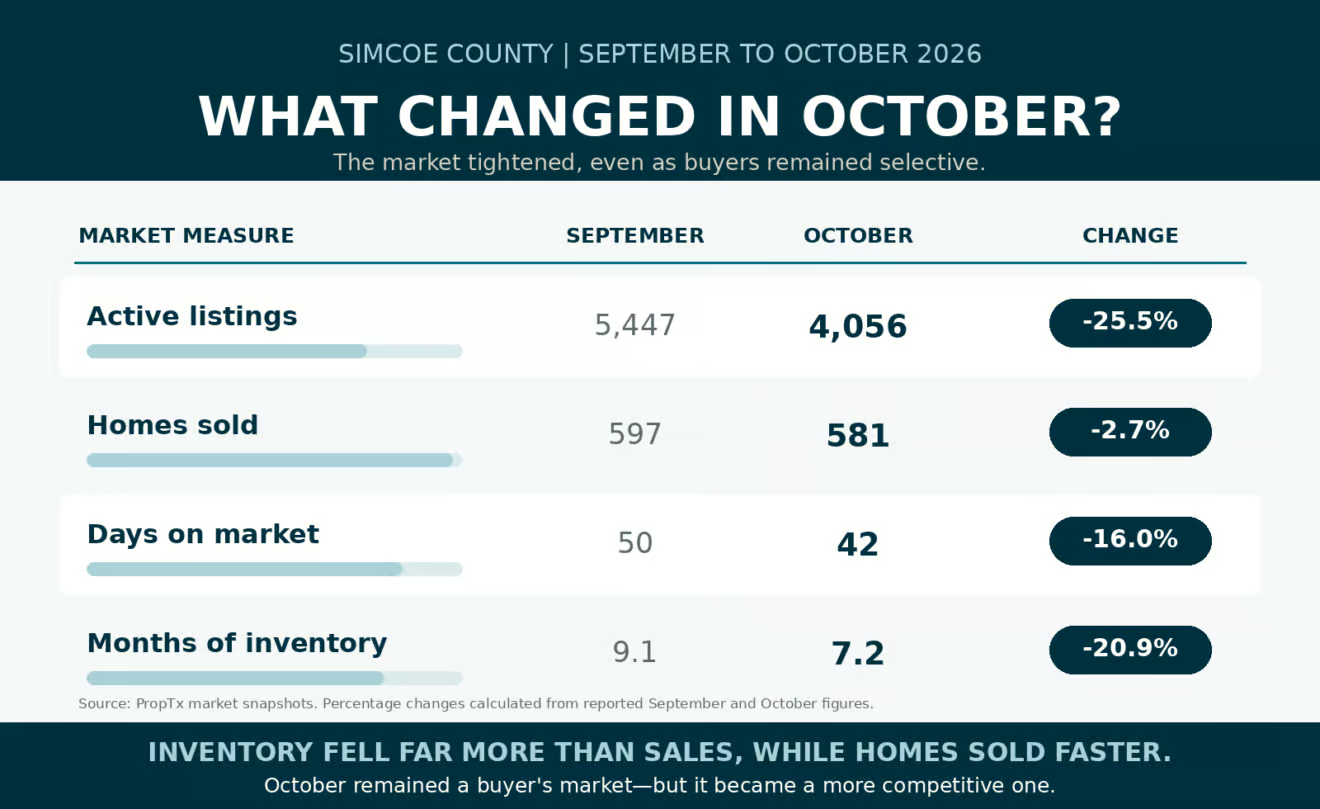
Active listings across Simcoe County fell by more than 25%, yet sales declined by less than 3%.
Homes also sold faster. Average days on market improved from 50 to 42, while months of inventory dropped from 9.1 to 7.2.
That is not a booming market. But it is a market that tightened noticeably.
What the Numbers Actually Mean
Some of the decline in inventory was seasonal. Listings expire, sellers withdraw due to market fatigue, and others decide they would rather not have people touring their home while they are putting up the Christmas tree.
What matters is that demand held up considerably better than supply. Nearly as many homes sold in October as in September, but buyers were choosing from a much smaller selection.
At 7.2 months of inventory, Simcoe County remains in buyer’s-market territory. Buyers still have time, negotiating power and the ability to include reasonable conditions. However, the balance moved somewhat closer to sellers.
A properly priced home in a desirable location can still attract immediate attention. There is always a market within the market—and nowhere is that more obvious than at the upper end.
Prices Were Softer once more—but Averages Can Mislead
The average detached home sold for $791,027 in October. Townhouses averaged $584,664, while condominiums averaged $427,370.
Semi-detached homes were the exception, rising more than 18% from September to an average of $677,031.
Did every semi-detached home suddenly become 18% more valuable? NO!
Monthly averages can move substantially depending on the number, location and quality of properties that happen to sell. The sharp increase in the semi-detached average is a useful reminder that one regional statistic should never be mistaken for the value of an individual home.
Averages describe the group. Comparable sales determine the property.
Above $1.5 Million, the Market Plays by Different Rules
The higher-priced executive and waterfront market is not inactive. It is thin—which is an important distinction.
Across all of Simcoe County, 272 detached waterfront properties were available at the beginning of November, while only 24 sold during October. Waterfront sales took a median of 46 days, compared with 29 days for non-waterfront homes, and achieved approximately 95% of their final (many times reduced) asking price.
That tells us buyers have time and negotiating room. It does not tell us that exceptional waterfront is unwanted.
Lake Simcoe recorded 23 waterfront sales above $1.5 million through October, with a median selling price of $1.95 million. Thirteen sold between $1.5 million and $2 million, only 2 above $2 million. Qualified buyers exist. There are simply fewer of them—and they tend to be very particular.
In this category, buyers are not just comparing countertops and bedroom counts. They are comparing privacy, frontage, shoreline usability, exposure, water depth, docking, views, architecture and the cost of replacing what has already been created.
A beautiful house with difficult water access may compete very differently from a smaller home with exceptional shoreline. Waterfront is not one market. It is a collection of very different shorelines with houses attached to them.
Executive homes above $1.5 million face a similar challenge. With only 18 sales above $1.5 million in October, the majority were in the Collingwood area. Without the natural scarcity of waterfront, the property must make its value clear through location, lot, architecture, condition, privacy and presentation.
Being large and expensive is not, by itself, a marketing strategy.
Luxury buyers may be less constrained by financing, but they are not indifferent to value. In fact, sophisticated buyers are often the quickest to recognize when an asking price is based on evidence—and when it is based mostly on enthusiasm.
Longer market time is not unusual at the upper end. But there is an important difference between patiently waiting for the right buyer and repeatedly waiting for the market to accept the wrong price.
Buyers Are Shopping by Payment, Not Just Price
The Bank of Canada’s quarter-point rate increase at the end of October adds another layer to the market. Its full effect is not being felt because many October sales were negotiated before the announcement.
Real estate has always been emotional. Lately, however, it has become remarkably common to add math as a now larger part of the equation.
Buyers are no longer simply asking, “Do we love the house?” They are asking, “What will it cost us every month—and are we comfortable with that number?”
The home may create the emotion. The numbers now have to give that emotion permission.
What This Means for Sellers and Buyers
Lower inventory is encouraging for sellers, but it will not rescue an unrealistic asking price.
Buyers are comparing your home with every similar property available, every recent price reduction and every alternative their monthly payment will allow.
A home priced properly at launch creates interest and urgency. A home priced too high may still receive online views, but views do not deliver deposits.
Eventually, the price is reduced into the range where it probably should have started. By then, it is no longer the exciting new listing. It is the familiar one buyers believe they can now negotiate.
Sellers must also separate what their property is worth from what they need to receive. What someone paid is part of the property’s history—not evidence of its current value.
For buyers, declining inventory means the best properties may not sit indefinitely. A buyer’s market should create confidence, not hesitation.
Our Thoughts in Summary
October’s market improved beneath the surface.
Inventory fell substantially, sales remained relatively steady and homes sold faster. At the same time, prices remained under pressure and buyers continued to be highly selective.
The market tightened. It has not turned.
And the further a property moves above the average price—or the more distinctive it becomes—the less useful the broad averages are. Luxury, executive and waterfront properties must be evaluated within their own smaller competitive market.
This is not a market for vague thinking, hopeful pricing or uncertain financing. It rewards buyers who understand their value equation and sellers who understand their genuine competitive position.
The market is not dead.
It has simply stopped giving anyone the benefit of the doubt.
David, Colton & Danielle Weeks
The Weeks Group

We’re In Your Corner
Get advice about buying or selling, relocating, or building your dream home from our local market experts.
