


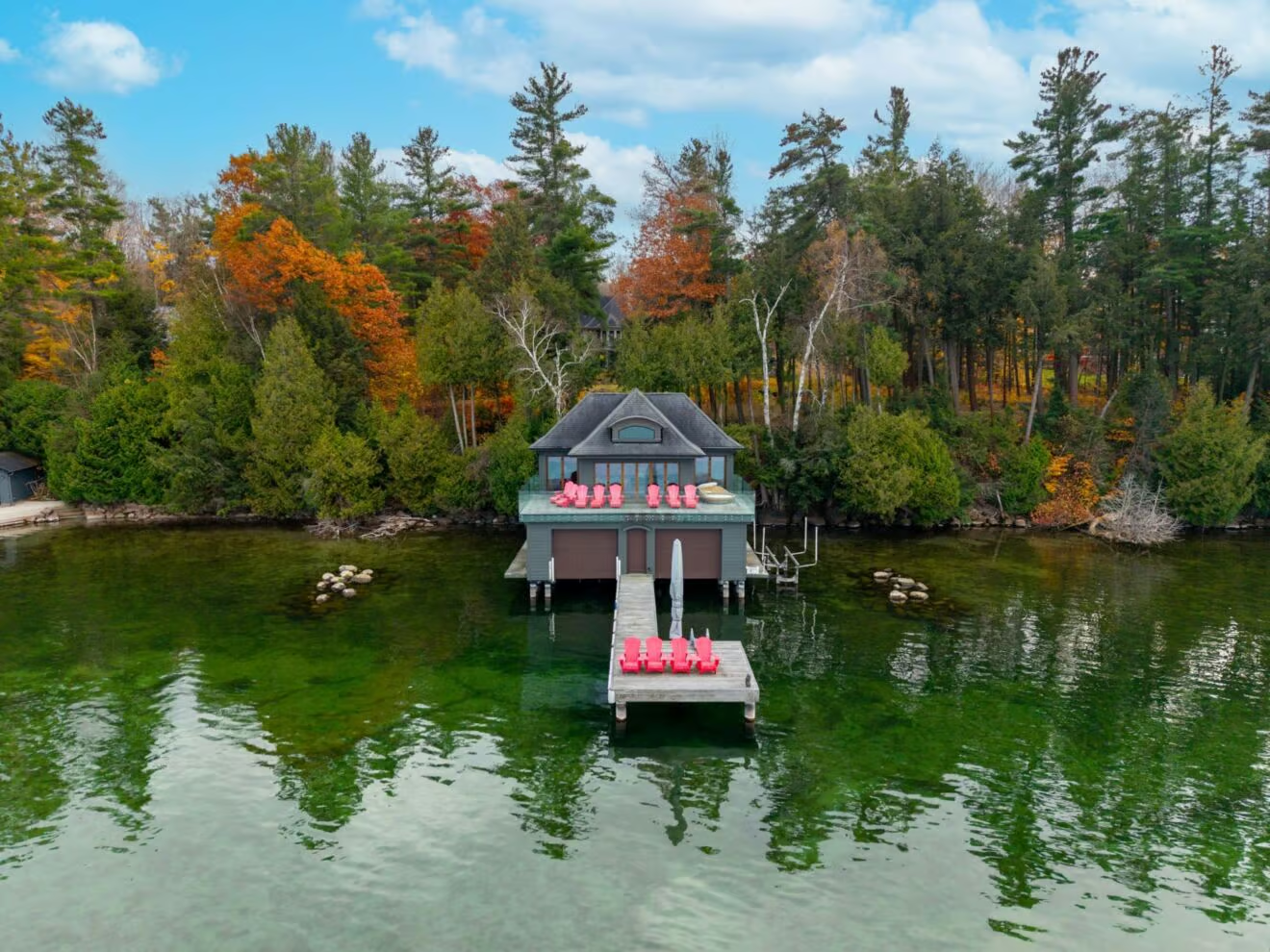
When buyers arrive at a waterfront property, their attention is obviously drawn to the lake, the home and the dock. Rarely does anyone ask to see a septic permit!
While listing a waterfront property in Barrie, we discovered that the City owned a one-foot portion of the concrete dock pad, for which both the current and previous owners had been paying approximately $500 annually. We brought the matter to the attention of the lawyer, who resolved the issue and had it removed from title before it could complicate the sale.
As the saying goes, the devil is in the details.
If you are contemplating the sale of your waterfront property, here are a few things we would encourage you to address before putting it on the market.
The following is intended as general information, not legal or tax advice.
Do you want to stay informed about what’s happening in Simcoe County and Barrie real estate? Get the latest news and early access to our listings by subscribing to our newsletter.
Before You List, Find the Paperwork Nobody Remembers Filing
Waterfront properties come with more history than most: decades of owners, a few additions, a dock or two, and at least one project that was “just a weekend job.” A buyer’s lawyer will ask for the records, so find the gaps yourself while there is still time to fix them.
Start a folder, paper or digital, with:
- The most recent survey or reference plan you have, showing the buildings and lot lines
- Septic permit, pump-out receipts and any inspection reports
- Well record and recent water test results, or details of your lake-water system if that is what you use
- Approvals for the dock, boathouse, seawall or any shoreline work
- Building permits for additions, decks and bunkies
- Road maintenance or association agreements, if your road is private
- Anything showing whether the shore road allowance in front of your lot was ever closed and purchased (more on that next)
If something is missing, that is useful information, not a catastrophe. Your municipality holds building and septic records, and your real estate lawyer can check title. It is far better to learn in March that the dock has no paper trail than to hear it from a buyer’s lawyer mid-negotiation.
The Shore Road Allowance: The Strip of Land You May Not Actually Own
Many older Ontario waterfront lots were surveyed with a strip of land between the lot line and the water, called an original shore road allowance. It was set aside in the original survey for a possible road. Your deed may not include it, even if your lawn, your stairs and possibly your dock sit on it quite happily.
Within a municipality, road allowances generally remain under municipal jurisdiction unless they were formally stopped up, closed and sold. Where Crown land or a Crown shoreline reserve sits between your lot and the water, the province is involved too. Ontario explains how this works in its disposition policy for road allowances and Crown shoreline reserves and on its page about municipal road allowances.
Why does it matter when you sell? Because a buyer’s lawyer will want to know whether the allowance in front of your lot was closed and conveyed, and whether anything sits on it: a dock, stairs or a boathouse. Not every lot has an unclosed allowance [CONFIRM: no lot-by-lot statement is made; a lawyer should confirm for each property], but you should know your answer before an offer arrives.
Start with your real estate lawyer and your municipality [CONFIRM: which department handles shore road allowance enquiries in Barrie, Oro-Medonte, Innisfil and Orillia]. Buying an allowance is a formal municipal process and timelines vary, so do not improvise it mid-negotiation. Our post on riparian rights covers what waterfront ownership includes.
Thinking about selling on the water? Keep reading the posts below:
- Riparian Rights: What to Know When Selling a Waterfront Home
- What to Look for in a Waterfront Home in Barrie
- What Not to Fix When Selling Your House
Docks, Boathouses and the Conservation Authority (Yes, Really)
A dock your family has used for decades is a tradition. To a buyer’s lawyer it is a question: who approved it, and who owns the land under it?
Several layers of rules can apply, and one does not replace another:
- The conservation authority. In its regulated areas, the Lake Simcoe Region Conservation Authority requires permission for work such as building a structure, site grading, and placing or removing material. Under Ontario Regulation 41/24, a seasonal or floating dock is exempt only if it is 10 square metres or less, needs no permanent supports and can be removed in a flood. Larger or permanent docks, and boathouses, may need a permit. LSRCA’s regulation map shows whether a property is regulated, and its permit page explains the process.
- The province. A Public Lands Act work permit can be required for certain work on shore lands, including dredging, filling, and structures touching more than 15 square metres of shore land on or close to Crown land. Ontario is clear that a conservation authority or municipal permit does not replace one.
- The municipality. Zoning and building rules apply on top of both. [CONFIRM: whether any federal rules apply to the specific property, for example along the Trent-Severn Waterway, and re-check current Public Lands Act exemptions, which were amended by O. Reg. 124/26]
Not every stretch of shoreline falls under the same conservation authority [CONFIRM: which authority regulates each property, by address], so check the property, not the lake.
Gather every approval you have, and if the paper trail is thin, ask the conservation authority and your lawyer what to do before you list. And please do not rip out, regrade or “tidy up” the shoreline the week before the photographer arrives. That is exactly the kind of work these rules cover.
Your Neighbour’s Sale Is One Data Point, Not a Verdict
Square footage is the least interesting number on the page. What moves value is the frontage, how deep the water is at the dock, the shoreline itself, exposure, privacy, how usable the access is, and whether the structures are approved and in good repair.
That is why the house down the road that sold last spring is a starting point, not an answer. Two properties can look identical in a listing and behave nothing alike on the water, and comparable sales have to be genuinely comparable.
A waterfront listing that starts too high does not get a second first impression, and our post on the signs a house might be over-priced applies here with the volume turned up. To see how buyers weigh these features, read Is Bigger Better When Buying a Waterfront Home? and Should You Buy a House Directly on the Water or Just Nearby?
When to List: Is It Really Summer or Nothing?
Summer shows a lake at its best, and that is not nothing. A dock in the water and a sunny deck do a lot of the selling on their own.
But the calendar is a less useful guide than the file. We would rather list with complete paperwork, a safe dock and a well-presented shoreline than rush to hit a particular month. If the survey, septic and permit questions take until spring to settle, that is a reasonable use of the winter. [CONFIRM: we have no local board data on seasonal timing, so this post makes no claim about which month sells best]
Planning to sell your home in Simcoe County? The Insider’s Guide To Selling is a must-have resource, and it’s free! Download your copy today.
What the Buyer’s Conditions Will Look Like
Expect the usual conditions (financing, inspection, insurance, title review) plus a few that waterfront properties attract:
- Septic. Septic systems up to 10,000 litres a day are covered by the Ontario Building Code. In most cases the municipality enforces the rules, though sometimes a health unit or conservation authority is the responsible authority; Ontario.ca explains the roles. Pump-out receipts and an inspection report help. [CONFIRM: whether a mandatory septic maintenance inspection program applies near the Lake Simcoe shoreline in each municipality]
- Well water. Ontario has guidance on testing and treating private wells, and the Simcoe Muskoka District Health Unit lists drinking-water testing for private water sources.
- Disclosure. A seller must disclose latent defects, meaning those that make a property unfit for habitation or dangerous and that a reasonable inspection would not reveal, and must not try to conceal other defects. RECO explains this in Bulletin 7.4. If you are unsure whether something counts, ask your lawyer before you list.
A buyer who wants the septic tested and the dock checked is not being difficult. They are being thorough about a large purchase.
The Tax Question: Ask the Accountant First
Nobody enjoys the tax conversation, which is why it should happen before you list, not after closing.
In general terms, the CRA says a cottage can qualify as a principal residence, but a family can designate only one home as its principal residence for any given year. If the waterfront property was not your principal residence for every year you owned it, part of the gain may be taxable. The sale of a principal residence must also be reported on your tax return, with Form T2091(IND), even when no tax is owing. The CRA explains the rules on its principal residence page.
What that means for you depends on how long you owned the property, how it was used and what else your family has designated. That is a job for an accountant, not a blog, even a good one. Our post on the principal residence exemption in Canada is a useful starting point. [CONFIRM: re-check the CRA capital gains rules before publishing; this post states no inclusion rate]
None of this is glamorous. Most of it is a folder, a few phone calls and some honest answers, and it turns the paperwork from a mid-negotiation emergency into a line on a checklist.
The view sells the property. The paperwork lets it close.
Whatever your next steps may be, our Barrie real estate agents are happy to help. Reach out to us today at 705.305.4174 or email hello@weeksgroup.ca to begin a conversation.

We’re In Your Corner
Get advice about buying or selling, relocating, or building your dream home from our local market experts.