


Buying a home is often comparable to a math equation:
Family income + down payment divided by interest rates multiplied by stress and indecision and divided further by market and economic uncertainty = house.
But anyone who has spent time sitting in a car in the driveway having an emotional late-night home buying discussion knows something very different. Buying a home is a psychological process inside the costume of real estate.
As we have said before, studies in consumer behaviour and real estate psychology have long said that emotion drives a large percentage of purchasing decisions (estimated at around 70%).
Ready to start your home search in Barrie or Simcoe County? Start here with our featured properties.
Game Over: This House Is SOLD
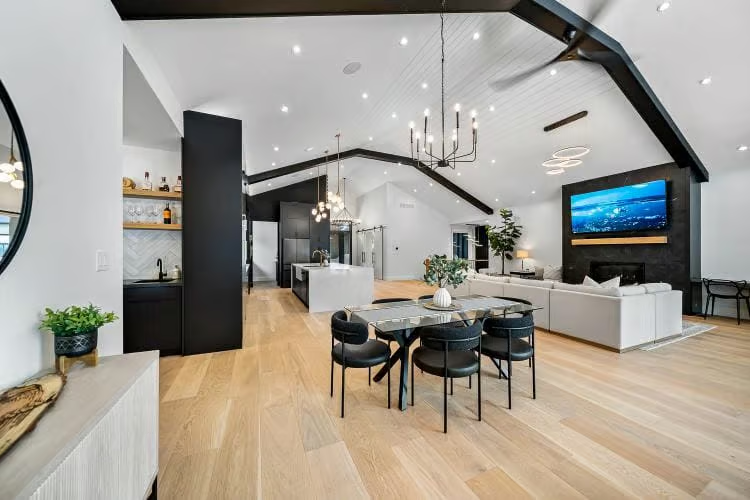
Spreadsheets of numbers don’t decide when a purchase is made. In the end, it’s sometimes done in the ten minutes of someone standing in the middle of the living room and whispering, “I can picture Christmas here.”
As a rule, women feel. Men take measurements. Now, before anyone starts firing emails at us, these are obviously very broad generalizations. Every buyer is different. Every person is unique.
We’ve represented incredibly practical women and also some highly emotional men. But after decades of helping people buy homes, some patterns show up again and again.
Women often notice:
- How the entrance and house overall feels
- Natural light and how it plays with colours in the home
- Flow of the home for the family’s schedule and activities
- Proximity to schools, parks, grocery stores, and rec centres
Men often have different priorities:
- Flooring quality
- Mechanical systems of the home
- Furnace age and efficiency
- Roof condition and age
- The width and depth of the garage
- General construction quality
One is imagining life while the other is calculating maintenance utility, and frankly, both are right. We’ve shown homes where the husband spent 20 minutes inspecting hardwood thickness and the quality of the installation, while the wife had already mentally arranged furniture and picked where the Christmas tree would go.
By the time he finished discussing furnace efficiency, she had already emotionally moved in. And the transaction was pretty much complete.
Buying psychology also matters when selling a house. To get the best results, read the posts below:
- Checklist for Selling a House
- 5 Tips For Selling A Waterfront Home
- Should You Stage Your Home Before Selling?
The Kitchen Test Is Real
If you want proof that emotion matters, watch what happens in kitchens. This is where people hang out and conversations happen. Smiles happen with family and friends.
For many buyers, the kitchen is the emotional command centre of the home. It represents family connection, entertainment, daily routine and also comfort. Even buyers who claim they “don’t cook much” still emotionally react to kitchens.
At the same time, someone else might be in the background, opening cabinet doors like amateur home inspectors. Which brings us to another hidden force in home buying…
The Parents Have Entered The Chat
Young couples buying their first home rarely buy alone anymore. Parents are deeply involved. Emotionally, financially, psychologically, or all three.
Sometimes they’re helping with down payments. Sometimes, they’re offering guidance on home-buying factors from their experience. Often, they’re simply trying to protect their kids from making expensive mistakes.
In today’s market and world, that involvement often makes sense. But it creates an interesting dynamic. Many times, the toughest negotiations aren’t with the actual buyers…It’s with Mom and Dad.
Suddenly, every father who hasn’t touched a wrench since they bought their first home in 1980 becomes a structural engineer during the home inspection, while the actual home inspector is quietly wondering if he should hand over the clipboard.
Winning over parents matters more than many sellers realize, especially with first-time buyers. Trust becomes a huge part of the process. Parents are often evaluating not just the house, but also the Realtor and the advice from all parties involved on behalf of their kids.
A good Realtor understands this dynamic instead of fighting it.
Are you planning a purchase and want to ensure you make the best decision now and in the future? The posts below will help you stay on track:
- Why Buy a Home in Snow Valley?
- What to Look for in a Waterfront Home in Barrie
- How Much Does It Cost to Build a House?
Neighbourhood Psychology Is Different Too
Men and women also tend to evaluate neighbourhoods differently. Women are often more tuned into amenities, schools, walkability, family routines and community feel while men often notice commuting routes, lot sizes, garage potential, privacy and future resale value given neighbourhood popularity.
And then there’s the emotional wildcard nobody talks about enough:
Status Psychology
Some buyers want privacy. Others want prestige. Some want the best street in the most talked-about neighbourhood in the area. Some want the quiet cul-de-sac where kids still ride bikes.
People are not just buying homes. They’re buying and establishing their identity.
Pregnant Buyers and “Nesting Mode”
There is also a very real psychological shift that happens when couples are expecting a baby.
These buyers can become intensely emotionally connected to homes because of what psychologists refer to as “nesting instincts.” Suddenly details that never mattered before become critically important:
- Bedroom proximity to the nursery
- Safety of the home for when they become toddlers
- Noise that can carry through the house
- Backyard fencing
- Schools- where we have had numbers of buyers only want to be located in the catchment zone of certain schools with reputation or status
- Bathtub size
- Laundry rooms and where and how big and how bright
We’ve seen buyers walk into homes completely unsure and then step into a nursery-sized bedroom and instantly become emotionally attached. We witnessed this just a few years ago, when buyers place an offer on a home that was missing almost everything they had insisted were “must-haves”.
So Who Actually Makes This Decision?
This is the funny part. People often ask us when they reflect on their own purchase: “Who usually wins in a couple’s buying decision?”
Generally, it’s the person with the stronger emotional conviction. And surprisingly, that is not always who you think it will be, not even in a couple you know very well.
Research in consumer decision making often suggests women heavily influence home buying decisions because they are typically more emotionally connected to the day-to-day functionality of the home. But men often influence the financial comfort level and perceived long-term practicality and investment value.
In healthy buying decisions, both psychologies matter. The best purchases usually happen when both align. We always hope to hear that magical moment where one person says:
“I love it.” And the other says, “I think it’s actually a smart buy.” That’s usually a sign you’ve found your house.
How To Buy A Home Without Letting Emotion Destroy Your Budget
Now let’s be clear. Emotion matters, but so does reality.
A home still needs to fit comfortably within your overall finances. Nobody wants to become “house poor,” where every dollar goes toward the mortgage and taxes and utilities while life itself disappears.
Because the wrong emotional decision can become stressful very quickly once the bills start flowing. The right emotional decision? That’s where homes become memories.
How Great Realtors Quietly Manage The Psychology
One of the biggest misconceptions about real estate is that Realtors simply open doors and wait for buyers to decide, and unfortunately, this happens.
In reality, a large part of what experienced Realtors do is quietly and gently manage emotion, expectations, psychology, and factors for decision-making throughout the process.
At The Weeks Group, one of the most important things we do happens long before we ever step into the first showing.
We spend a great deal of time understanding:
- What buyers truly need versus what they think they want
- How much they can comfortably afford
- The kind of lifestyle they are actually trying to create for their family
And those things sometimes need gentle reminders but can be subject to change as we see more and more homes. Sometimes buyers begin searching for one type of home and slowly drift emotionally toward something completely different.
A couple may initially state that they only want a newer home. Then suddenly they fall in love with a charming older property because of character, warmth or location.
Or buyers who swore they would never leave the city suddenly walk into a quiet country property and emotionally decompress within thirty seconds. This is where experience matters.
A good Realtor gently helps buyers stay grounded in what they originally said mattered most while still recognizing that emotion is part of the process- but also recognizing how needs and wants may translate differently from what was originally imagined.
Sometimes we find ourselves softly reminding clients:
- “Remember, schools and walkability were extremely important to you.”
- “And don’t forget that you wanted to avoid major renovations.”
- “Plus, your long-term plan was to stay here at least ten years, so this home may not suit you for the longer term.”
Not because we want to steer people, but because emotional buying can create emotional blind spots.
The Fine Line Between “Dream Home” and “Overpaying”
Another major part of our job is advising buyers on value and sometimes that means having uncomfortable conversations.
There are homes that are beautifully marketed, beautifully staged, and emotionally magnetic… but simply overpriced for the current market. This happens more often than buyers realize. A home can feel perfect but not represent strong value as a current investment.
At The Weeks Group, we spend enormous time studying pricing trends, neighbourhood results, inventory levels, buyer demand, and negotiating leverage. We have written extensively in our negotiation blogs about how strategy, timing, positioning, and market psychology often matter just as much as price itself.
And yes, negotiation absolutely matters!!!
Long-Term Planning and Buying for the Right Reasons
This is where experience becomes incredibly valuable, but there are also times when we can only move a seller so far. Sometimes, a seller is emotionally attached to a number.
Lately, we have been running into sellers who will be losing money in their sale because of how they bought. And in those moments, part of our responsibility is helping buyers understand the longer-term financial implications of a purchase.
We may advise and have absolutely done so:
“If you needed to sell this home again within two or three years, there is a chance you may not recover what you paid.”
That does not automatically mean it is a bad purchase. If buyers are planning to stay long term, raise a family, build memories, and enjoy the lifestyle the home provides, short-term market fluctuations may matter far less. But buyers deserve honest advice. That’s why we are here doing what we love most.
Because real estate is not just about helping someone buy a home. It is about helping them make a decision they can feel good about years later and tell us how wonderful they think we are when we see them about town.
Whatever your next steps may be, our Barrie real estate agents are happy to help. Reach out to us today at 705.305.4174 or email hello@weeksgroup.ca to begin a conversation.

We’re In Your Corner
Get advice about buying or selling, relocating, or building your dream home from our local market experts.